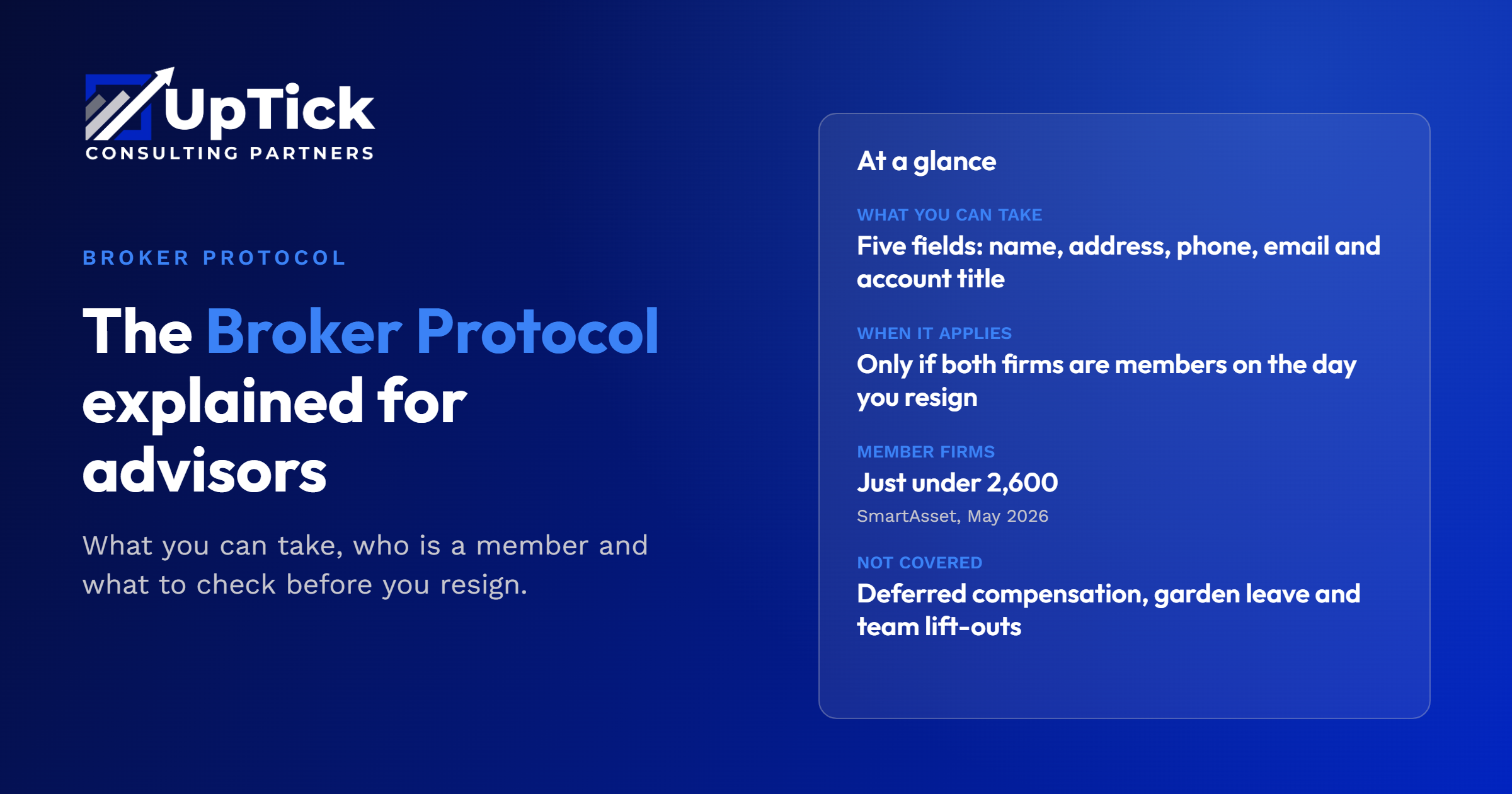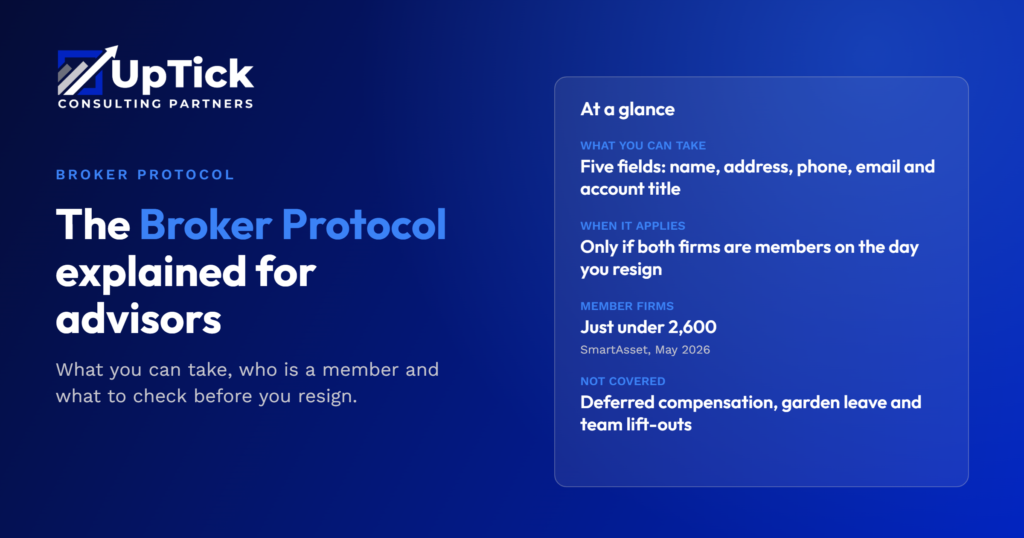
Short answer: The Broker Protocol is a voluntary agreement among member firms, started in 2004, that lets a departing advisor take five pieces of client contact information (name, address, phone, email and account title) without being sued over it. It applies only if both your current firm and your new firm are members when you resign.
Last updated November 21, 2026. Written by Marc Elia, Founder, UpTick Consulting Partners.
Key takeaways
- The Protocol covers five client fields and nothing more.
- Both firms must be members on the date you resign. SmartAsset reported just under 2,600 member firms in May 2026.
- You resign in writing and hand your current firm the client list at that time.
- It does not cover deferred compensation, garden leave or team lift-outs, and it does not override privacy rules.
- Membership changes. Morgan Stanley and UBS both left in late 2017.
If you are thinking about a move, the Broker Protocol is one of the first things to check. It decides what you can bring, what you must leave and whether your current firm has a reason to sue. This guide covers what it says, who is in it and how a departure under it works.
What is the Broker Protocol?
The Protocol for Broker Recruiting was signed in 2004 by Smith Barney, Merrill Lynch and UBS to cut the litigation that followed every advisor departure (Kitces; WealthManagement). Signatory firms agree not to sue a departing advisor, or the new firm, over a narrow set of client information taken when the advisor moves from one member to another.
Joining takes a signed joinder agreement returned to the administrator. Leaving takes a letter of withdrawal. J.S. Held administers it and keeps the member list, which it says it updates weekly. SmartAsset reported just under 2,600 member firms as of May 2026.
What client information can you take under the Broker Protocol?
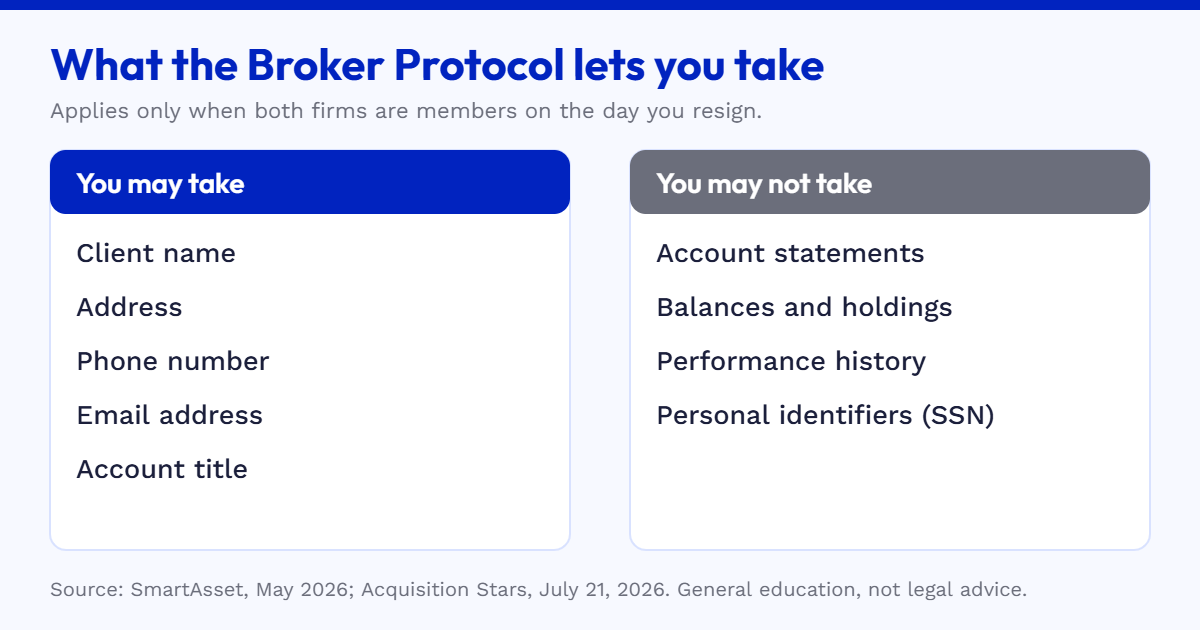
| You may take | You may not take |
|---|---|
| Client name | Account numbers, beyond what you disclose to your current firm at resignation |
| Address | Account statements and copies of client files |
| Phone number | Balances, holdings and performance history |
| Email address | Social Security numbers, dates of birth and other personal identifiers |
| Account title | Firm proprietary materials |
The list is limited to clients you personally serviced. Under the usual reading, your new firm may not use the list for its own marketing, and only you contact those clients (SmartAsset, May 2026).
Who is a Broker Protocol member?
Membership is by firm entity, so the entity you work under matters, and the list changes. Comply reported in 2025 that a growing number of firms have left the Protocol, citing mergers and acquisitions, recruiting strategy and adviser retention.
Two of the three founders have exited. Morgan Stanley left effective around the end of October 2017, and UBS left effective December 1, 2017, saying its model had shifted toward retaining advisors (InvestmentNews, November 27, 2017; ThinkAdvisor, December 4, 2017). Merrill Lynch said in December 2017 that it would stay. Check the current list for any firm, including your own, before you plan around it.
How does a departure under the Broker Protocol work?
The steps below follow the guidance in SmartAsset (May 2026) and Acquisition Stars (July 21, 2026). Your attorney should confirm each one for your situation.
- Confirm membership. Verify that both firms are members close to your resignation date.
- Review your agreements. Read your employment, compensation and non-solicitation terms separately from the Protocol.
- Prepare a limited list. Include only the five permitted fields, for clients you actually serviced.
- Hold it until you resign. Do not solicit clients or copy other firm records beforehand.
- Resign in writing. Give your current firm a copy of the client list, with the account numbers tied to those clients, when you resign.
- Return firm property. Phones and laptops may hold information the Protocol does not allow you to take.
- Coordinate the move. Plan with the new firm so client communication and account transfers follow promptly. Clients decide whether to move.
What does the Broker Protocol not cover?
- Deferred compensation. Forfeiture terms in your plan documents still apply.
- Garden leave. If your agreement requires it, the Protocol does not remove it.
- Team lift-outs and firm deals. These need separately negotiated agreements.
- Privacy rules. Kitces notes that Protocol membership does not override Regulation S-P, so firm privacy policies and client opt-outs still matter.
- Moves involving a non-member. The Protocol does not apply, and the firm you leave may seek an injunction (Acquisition Stars, July 21, 2026).
How does this fit with the rest of your move?
The Protocol is one input. Compare your options first with our guide to independent broker-dealers, RIAs and hybrid firms, then see how advisor transition packages work and whether going independent is worth it. If an RIA is on your list, read how RIAs recruit experienced advisors.
Frequently asked questions
What is the Broker Protocol in simple terms?
It is a voluntary agreement among member firms, started in 2004, under which a departing advisor may take five pieces of client contact information to a new member firm without being sued over it. The five are name, address, phone number, email address and account title. It applies only when both firms are members on the day you resign.
Is my firm a Broker Protocol member?
Check the member list kept by J.S. Held, the administrator, and check it close to your resignation date, because firms join and leave. Also confirm the exact legal entity you work under and the entity you are joining, since membership is listed by entity. Your attorney can confirm both.
Can I take account numbers or statements under the Broker Protocol?
No. Account numbers, statements, balances, holdings, performance history and personal identifiers such as Social Security numbers are outside the Protocol. You give your current firm the account numbers tied to the clients on your list at resignation, but you do not take them with you.
What if my firm is not a member?
Then the Protocol does not apply, and your employment agreement and the law govern. Non-solicitation and confidentiality terms can limit what you take and who you contact, and a firm outside the Protocol may seek an injunction. Talk to your own attorney before you act.
Does the Broker Protocol protect me from every claim?
No. It addresses the five client data fields. It does not settle deferred compensation, garden leave, team lift-outs or other terms in your agreements, and it does not override privacy rules such as Regulation S-P. Have your attorney read your agreements before you resign.
Talk it through confidentially

Book a confidential 30-minute call
If you are weighing a move and want to understand where the Protocol fits, book a confidential 30-minute call with Marc Elia. You can also call 646.734.0334 or email marc@uptickrecruiting.com. For more, browse the guides in the Advisor Transition Knowledge Center. Receiving firms pay our fee.
About the author
Marc Elia, Founder, UpTick Consulting Partners. Marc leads a boutique firm that helps experienced financial advisors compare transition paths across wirehouses, independent broker-dealers, hybrid models and RIAs.
Sources
- J.S. Held, The Broker Protocol (administrator page and member list)
- SmartAsset, Understanding How Broker Protocol Impacts Financial Advisors, member count as of May 2026
- Acquisition Stars, Protocol for Broker Recruiting Explained, July 21, 2026
- InvestmentNews, UBS broker-protocol exit, November 27, 2017
- ThinkAdvisor, Merrill to stay in Broker Protocol, December 4, 2017
- Comply, Understanding the Broker Protocol in 2025
- Kitces, Broker Protocol recruiting requirements (undated)
Figures and firm status come from the named sources on the dates shown and can change. Terms and processes vary by firm. UpTick is not affiliated with any firm named here. This is general education, not investment, tax or legal advice. Talk to your own attorney before you resign.
About UpTick Consulting Partners
UpTick Consulting Partners (UpTick Recruiting LLC) is a boutique financial advisor recruiting and transition consulting firm based in Red Bank, NJ. We help experienced advisors evaluate moves between wirehouses, independent broker-dealers, hybrid models and RIAs. Receiving firms pay our fee. UpTick is not an investment advisor. uptickrecruiting.com