By Marc Elia, Founder, UpTick Consulting Partners · Updated October 9, 2026
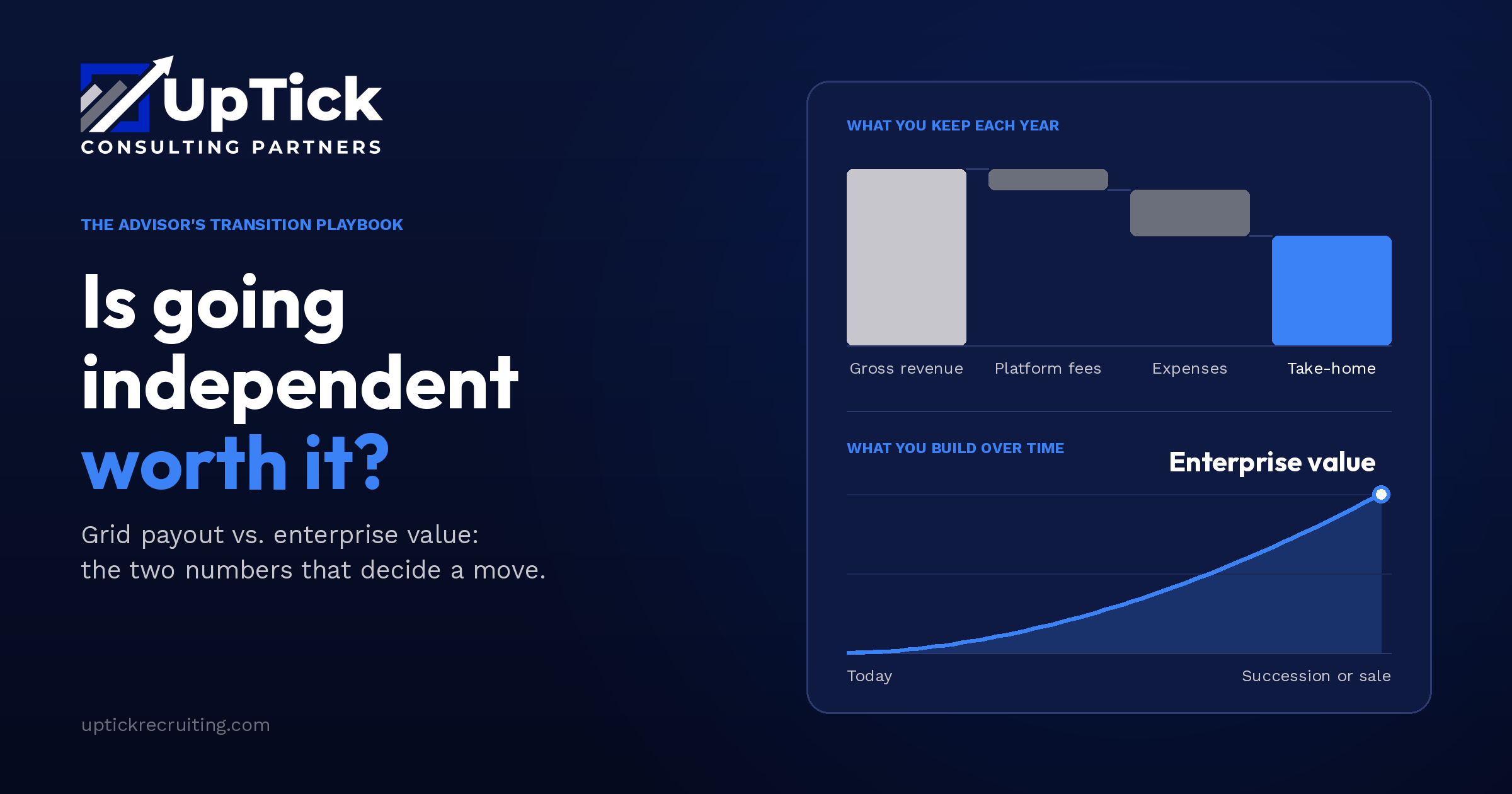
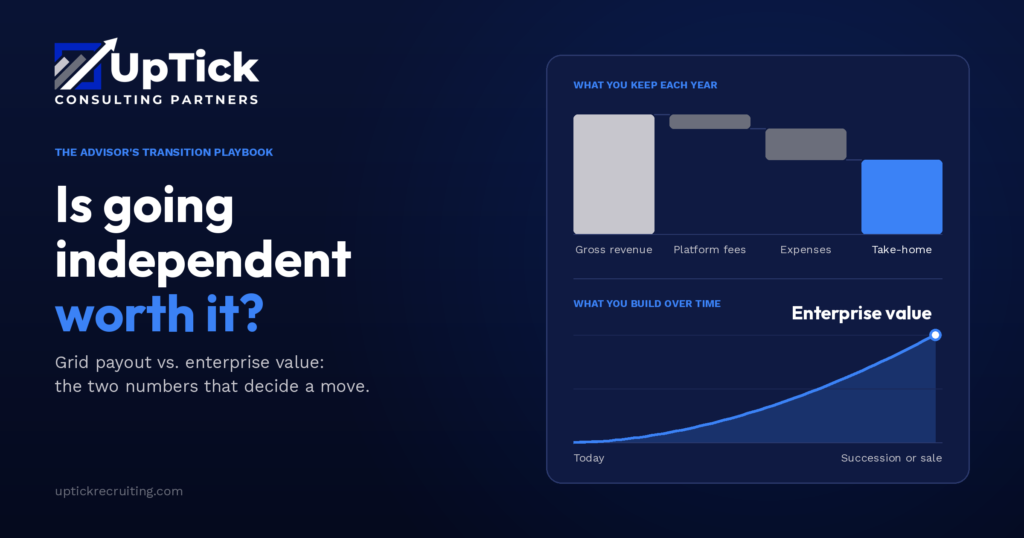
The short answer: Going independent is worth it for a financial advisor when two numbers beat the status quo together: annual take-home after expenses, and the enterprise value of a business the advisor owns. A higher payout percentage alone doesn’t prove a move pays. Wirehouse employees are paid on a production grid and generally don’t own a sellable business. Independent advisors keep a larger share of revenue, pay their own expenses, and build equity they can sell or pass to a successor.
Key takeaways
- The economics of a move have two parts: what you keep each year and what you build over time.
- Independent take-home = gross revenue − platform or broker-dealer fees − operating expenses.
- Enterprise value is what your practice is worth as a sellable asset. Wirehouse employees generally don’t build it. Owners and equity partners do.
- A transition deal or signing bonus is one input. Don’t use it as the deciding factor.
- Run the numbers on your own P&L before you compare firms. A single quoted take-home percentage tells you little.
What are breakaway advisor economics?
Breakaway advisor economics is the financial comparison an advisor makes before leaving a wirehouse or other employee firm for an independent model. It covers three things: annual take-home pay, the costs the advisor takes on, and the enterprise value the advisor can build and later sell.
How is a wirehouse financial advisor paid?
A wirehouse advisor is an employee paid on a compensation grid: a payout percentage of the revenue they produce, set by the firm. The firm covers office space, staff, technology, compliance, and brand. Grid rates, deferred compensation, and bonus rules are set by the firm and can change from year to year. The firm also typically controls the client relationship, which limits what the advisor can take or sell.
How much does an independent financial advisor keep?
An independent advisor keeps a much larger share of the revenue they generate, but pays costs the firm used to cover. The formula is:
Take-home = gross revenue − platform, custodian, or broker-dealer fees − operating expenses
Operating expenses usually include staff, office space, technology, compliance support, insurance, and marketing.
For most established advisors, independent take-home ends up higher. That’s not automatic, though. The gap depends on how lean you run the practice. Anyone who quotes you a single take-home percentage without seeing your P&L is selling, not advising.
What is enterprise value for a financial advisory practice?
Enterprise value is what an advisory business is worth as a transferable asset, usually expressed as a multiple of revenue or of profit (EBITDA). It’s what a buyer, partner, or successor would pay for the practice.
This is the part most payout comparisons leave out. Over a career, the equity an owner builds can be worth more than the year-to-year payout difference. A wirehouse retirement or sunset program pays a departing advisor over time for transitioning clients, but that isn’t the same as owning and selling a business.
Wirehouse vs. independent: how the economics compare
| Wirehouse (W-2 employee) | Independent broker-dealer | Hybrid RIA | Independent RIA | |
|---|---|---|---|---|
| Who sets your payout | The firm’s grid | Broker-dealer payout schedule | You, net of BD and custodian fees | You, net of custodian and platform fees |
| Who pays operating expenses | The firm | Mostly you | You | You |
| Do you own the business | Generally no | Yes, as an independent contractor | Yes | Yes |
| Can you sell it or pass it on | Through a firm sunset program | Yes | Yes | Yes |
| Who runs infrastructure | The firm | Shared with the broker-dealer | You, with BD and platform support | You, or an outsourced platform |
Terms vary by firm and by contract. Treat this as a general comparison and confirm the specifics for any firm you’re considering.
Why chasing the highest payout can backfire
Advisors who move for a few extra points of payout are often disappointed later. The higher percentage can be offset by expenses they didn’t model, a platform that doesn’t fit how they work, or a deal structure that ties them up for years. The moves that pay off weigh take-home, enterprise value, control, and fit together.
How to calculate whether going independent is worth it
- Start with your real numbers: trailing-12 production, assets under management, and how your book is split between fee-based and commission business.
- Model take-home in each channel: apply each firm’s payout or fee structure and subtract realistic operating expenses.
- Estimate enterprise value: decide what the business could be worth as an owned practice, and who would buy it.
- Add the transition terms: upfront money, forgivable loans, and how they’re repaid, after tax.
- Compare five-year outcomes: set staying side by side with each realistic alternative, covering both annual income and equity.
Where does a transition deal fit?
Recruiting packages, such as upfront payments, forgivable notes and back-end bonuses, can make a good move better. They’re designed to be compared on one headline number, though, and that number doesn’t capture the length of the commitment, the repayment terms, or how well the platform fits. Evaluate the deal after you’ve modeled take-home and enterprise value, not before.
How UpTick Consulting Partners helps advisors run the math
UpTick Consulting Partners is a financial advisor recruiting and transition consulting firm in Red Bank, New Jersey. We help experienced advisors compare wirehouse, independent broker-dealer, hybrid RIA, and RIA models using their own production and expense numbers. We aren’t tied to one model, and our fee is paid by the receiving firm, so there’s no cost to the advisor.
Frequently asked questions
Is going independent worth it for a financial advisor?
It’s worth it when the combination of annual take-home after expenses and the enterprise value of an owned business beats staying put. For many established advisors with portable client relationships, it does. The answer depends on your own P&L and goals.
How much more do independent advisors keep than wirehouse advisors?
Independent advisors keep a substantially larger share of revenue than a wirehouse grid pays, but they cover their own expenses. The real difference in take-home depends on your cost structure, so model it on your own numbers.
What is enterprise value for a financial advisor?
It’s the value of an advisory practice as a sellable asset, usually expressed as a multiple of revenue or profit. Owners and equity partners build it. Wirehouse employees generally don’t.
Is a large signing bonus a good reason to change firms?
A signing bonus can be part of a good move, but it shouldn’t decide one. Weigh it alongside take-home pay, enterprise value, contract length, and platform fit.
How do I calculate my take-home if I go independent?
Subtract platform, custodian, or broker-dealer fees and your operating expenses from your gross revenue. The UpTick transition value calculator gives a first estimate, which you should then check against your actual production and costs.
Who pays for a transition consultant like UpTick?
At UpTick Consulting Partners, the receiving firm pays the fee. Advisors pay nothing.
Run your own numbers. Start with the UpTick transition value calculator, then book a confidential 30-minute call to check the results against your real production: calendly.com/marc-uptick/30min
UpTick · 140 Broad Street, Suite 200, Red Bank, NJ · 646.734.0334 · marc@uptickrecruiting.com · uptickrecruiting.com