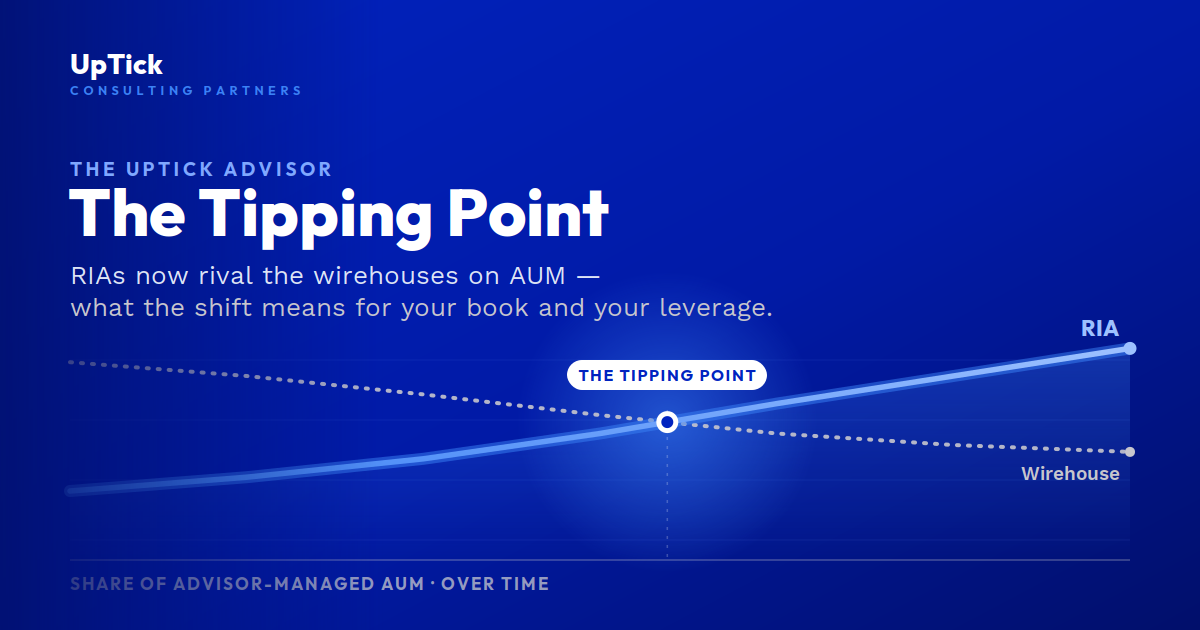
For years, the wirehouses were treated as the summit of a financial advisor’s career. That story is changing. Industry analysts long projected that independent RIAs would eventually hold a share of client assets rivaling the traditional wirehouse channel — and that crossover is no longer a forecast on a slide. It’s arriving. If you’re an experienced advisor, this isn’t abstract industry trivia. It reshapes your options, your leverage, and the math on your own next move.
What “the tipping point” actually means
The shift didn’t happen overnight. Over the past decade, assets and advisors have moved steadily out of the wirehouse and broker-dealer channels and into independent RIA models. What’s new is scale. The RIA channel has matured to the point where, by several industry measures, it now rivals the four major wirehouses — Merrill, Morgan Stanley, UBS, and Wells Fargo — in total assets under management.
The practical translation: “independent” no longer means “small” or “under-resourced.” The infrastructure gap that once made breaking away feel risky has largely closed.
Why the assets keep moving
Three forces, mostly. Economics — independent models can change the arithmetic on what an advisor keeps. Control — over technology, product access, and how you serve clients. And client experience — a fiduciary-first, planning-led model that many advisors find easier to defend.
None of these is new. What’s changed is that the supporting ecosystem — platforms, compliance support, and transition financing — has made the move accessible to teams of nearly every size.
What it means for your book
A maturing RIA channel gives your book more places to go and more leverage in the conversation. When multiple credible models compete for experienced advisors, the advisor sets more of the terms. Your leverage is highest before you’ve signaled where you’re leaning — which is exactly why a quiet, structured exploration beats an impulsive one.
What it means for your leverage as a recruit
Recruiting reporting through 2026 describes an unusually competitive environment, with strong deals available across channels. That competition works in your favor — but only if you understand your own numbers and options going in. An advisor who can articulate their book’s composition, growth, and portability negotiates from strength.
Frequently Asked Questions
Are RIAs really bigger than the wirehouses now?
By several industry measures, the RIA channel now rivals or exceeds the wirehouses in total AUM. Exact figures vary by source and methodology, but the direction of the trend is not in dispute.
Does this mean I should leave my wirehouse?
Not necessarily. It means you have more credible options than advisors did a decade ago. The right answer depends on your economics, your clients, and what you want to build — which is what a transition analysis is for.
Is independence realistic for a $25M–$100M advisor?
Increasingly, yes. Turnkey platforms and transition financing have lowered the barrier that once made independence practical only for very large teams.
Will the trend continue?
Industry leaders broadly expect breakaway movement and RIA growth to continue. Betting your career on a single forecast is unwise, but planning around a well-established, decade-long structural shift is prudent.
At UpTick, we specialize in helping advisors navigate transitions smoothly, profitably, and with confidence. From transition support to negotiating the best deal, we’ve helped advisors across the country build practices that reflect their vision.
 Ready to explore your options? Contact us at marc@uptickrecruiting.com to start the conversation.
Curious where your book fits in the new landscape?
Book a confidential 30-minute mapping call at calendly.com/marc-uptick/30min.