Short answer: The 2027 wirehouse compensation plans are out from all four firms. Morgan Stanley raised every payout grid threshold by about 10%. Wells Fargo lifted its monthly pay hurdle from $13,500 to $16,000. Meanwhile, Merrill and UBS kept their core grids the same. As a result, flat production will pay less at two of the four firms in 2027. So year-end is a smart time to compare your options.
Key takeaways: 2027 wirehouse compensation plans
- Morgan Stanley and Wells Fargo now ask for more revenue to earn the same pay.
- Merrill and UBS left their core grids alone. Instead, they changed bonuses and growth awards.
- Above all, deferred pay and growth awards now reward asset, lending and deposit growth.
- Deferred pay takes years to vest. For that reason, it also works as a retention tool.
- In short, a calm look at your numbers now keeps your options open.
What changed in the 2027 wirehouse compensation plans?
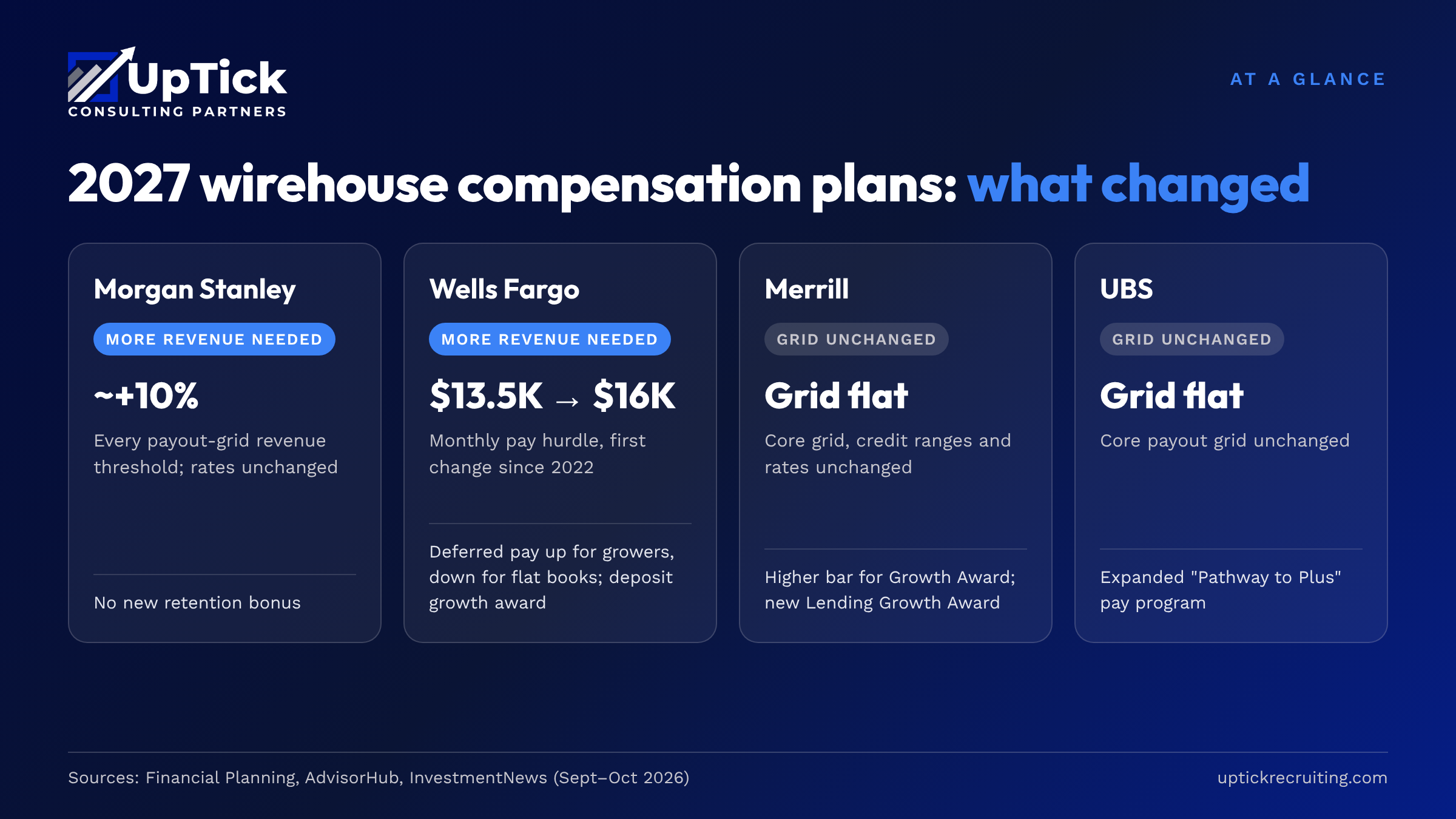
Morgan Stanley released the first of the 2027 wirehouse compensation plans in September. Wells Fargo came last, in late October. Here is how each plan moved, based on reports from Financial Planning, AdvisorHub, InvestmentNews and ThinkAdvisor.| Firm | Core grid or hurdle for 2027 | Other notable changes |
|---|---|---|
| Morgan Stanley | Grid thresholds up about 10%; rates unchanged | No new retention bonus |
| Wells Fargo Advisors | Monthly hurdle up to $16,000 from $13,500 (first change since 2022); 22% and 50% rates unchanged | More deferred pay for growing practices, less for flat ones; new deposit growth award |
| Merrill | Core grid, credit ranges and rates unchanged | Higher bar for the Growth Award; new Lending Growth Award |
| UBS | Core grid unchanged | Wider “Pathway to Plus” pay program |
Sources: Financial Planning, Oct. 2026; AdvisorHub, Oct. 29, 2026; AdvisorHub, Oct. 2026; InvestmentNews, Oct. 26, 2026.
What does the Wells Fargo hurdle change cost an advisor?
Today, Wells Fargo advisors keep 22% of the first $13,500 they produce each month. Above that line, they keep 50%. Next year, the line moves to $16,000. In other words, $2,500 more of each month’s revenue is paid at 22% instead of 50%. Here is the math. First, $2,500 times 12 months is $30,000 a year. Next, the gap between 50% and 22% is 28 points. So the cost is $8,400 a year. Compensation consultant Andrew Tasnady cited the same figure to Financial Planning. By contrast, Wells Fargo Advisors head Sol Gindi said the average advisor needs about 2% more production, or roughly $15,000, to make it up. Two details matter here. First, teams that produce $2 million or more are exempt, according to InvestmentNews. Second, the firm says average advisor revenue is up 57% since it last set the hurdle in 2022.What does Morgan Stanley’s 10% grid increase mean for you?
When every threshold rises about 10% and the rates stay put, flat production slides toward a lower band. Put simply, you take home less for the same work unless your revenue grows.Related: financial advisor recruiters who compare these offers side by side for experienced advisors.
Hypothetical illustration: say you sat just above a grid break in 2026. With the same revenue, you could land just below it in 2027. Then every dollar in that band pays at the lower rate. So map your 2026 production onto the new grid now, before your January statement does it for you.
Why is deferred pay the real story in the 2027 wirehouse compensation plans?
In the 2027 wirehouse compensation plans, the headline grids moved only a little. However, the bigger changes sit in deferred pay and bonuses:- Wells Fargo: deferred pay rises from 6% to 11% for growing practices, up from 5% to 10%. On the other hand, it falls to 3% to 8% for flat or shrinking ones. Advisors at $714,000 or less in revenue get none (Financial Planning).
- Merrill: a new Lending Growth Award pays a yearly cash bonus on net new lending (AdvisorHub).
- Across the industry: big firms hold back part of your revenue as deferred pay that vests over years. As a result, it keeps advisors in place as much as it rewards them (InvestmentNews).
Should the 2027 wirehouse compensation plans change when you move?
There is no single right answer. Still, in the moves we help advisors think through, the choice usually comes down to a few dates and dollar amounts:| Factor | Why it matters | What to check |
|---|---|---|
| Unvested deferred pay | Leaving before a vest date can forfeit it | Balance and vesting dates |
| Year-end bonuses | Some pay only if you are still employed on a set date | Payment dates and rules |
| Forgivable notes | Unforgiven balances usually come due when you leave | Balance and payoff schedule |
| Client workload | December is busy with distributions and tax work | Your calendar and team capacity |
| Your 2027 pay | Shows the true cost of staying put | Take-home at flat and growing revenue |
What are firms paying to recruit advisors right now?
Recruiting money usually comes as transition assistance. Typically, it is a forgivable loan sized to your trailing 12-month revenue and paid off over several years (InvestmentNews). Deals vary widely by channel, book and team. For example, AdvisorHub reported in March 2026 that UBS offered packages worth 550% of trailing 12-month revenue to advisors producing around $7 million or more. That offer paid about 250% upfront and came with a 16-year commitment. That said, the check is only half the picture. Research from Cerulli Associates, reported by The Daily Upside, found that about 72% of assets move within 12 months when an advisor leaves a wirehouse for independence. For this reason, every comparison needs a realistic retention estimate.What should you calculate before reacting to the 2027 wirehouse compensation plans?
- Start with your 2027 take-home under the new plan, at flat revenue and at a realistic growth rate.
- Next, list your unvested deferred pay and any notes, with exact dates.
- Then estimate what your practice is worth in each model: wirehouse, independent broker-dealer, hybrid and RIA.
- After that, apply a careful asset retention estimate and see what it does to year one income.
- Finally, weigh the fit: technology, support, culture, and control over how you serve clients.
Frequently asked questions
Do the 2027 wirehouse compensation plans cut advisor pay?
Not at every firm. Morgan Stanley raised its grid thresholds about 10%, and Wells Fargo raised its monthly hurdle to $16,000. So both now ask for more revenue for the same pay. Merrill and UBS, on the other hand, kept their core grids and changed bonuses instead.When does the Wells Fargo 2027 hurdle take effect?
It starts January 1, 2027, according to AdvisorHub. However, advisors and teams producing $2 million or more a year are exempt, per InvestmentNews.Will I lose deferred pay if I change firms?
Usually, yes. Unvested deferred pay is commonly forfeited when you leave, which is why it works as a retention tool. So check your plan for balances and vesting dates. In some cases, a new firm will factor unvested amounts into its offer, but terms vary.Is year-end a good time for a financial advisor to change firms?
It can be. Even so, it depends on your vesting dates, bonus rules, note balances and client workload. Many advisors use November and December to run the numbers. Then they time the move around those dates.Does it cost advisors anything to work with UpTick Consulting Partners?
No. Receiving firms pay UpTick Consulting Partners. Also, every conversation is confidential.See your 2027 numbers clearly
If the 2027 wirehouse compensation plans just changed the math on your practice, let’s walk through it together. We’ll look at what you’d earn if you stay, what your book is worth in each model, and whether the timing makes sense. It’s confidential. Book a confidential 30-minute callRead next
- Financial advisor transition packages: how to negotiate one
- Going independent in 2026: models, costs and steps
- Financial advisor transition consulting, explained
- Financial advisor recruiters at UpTick Consulting Partners